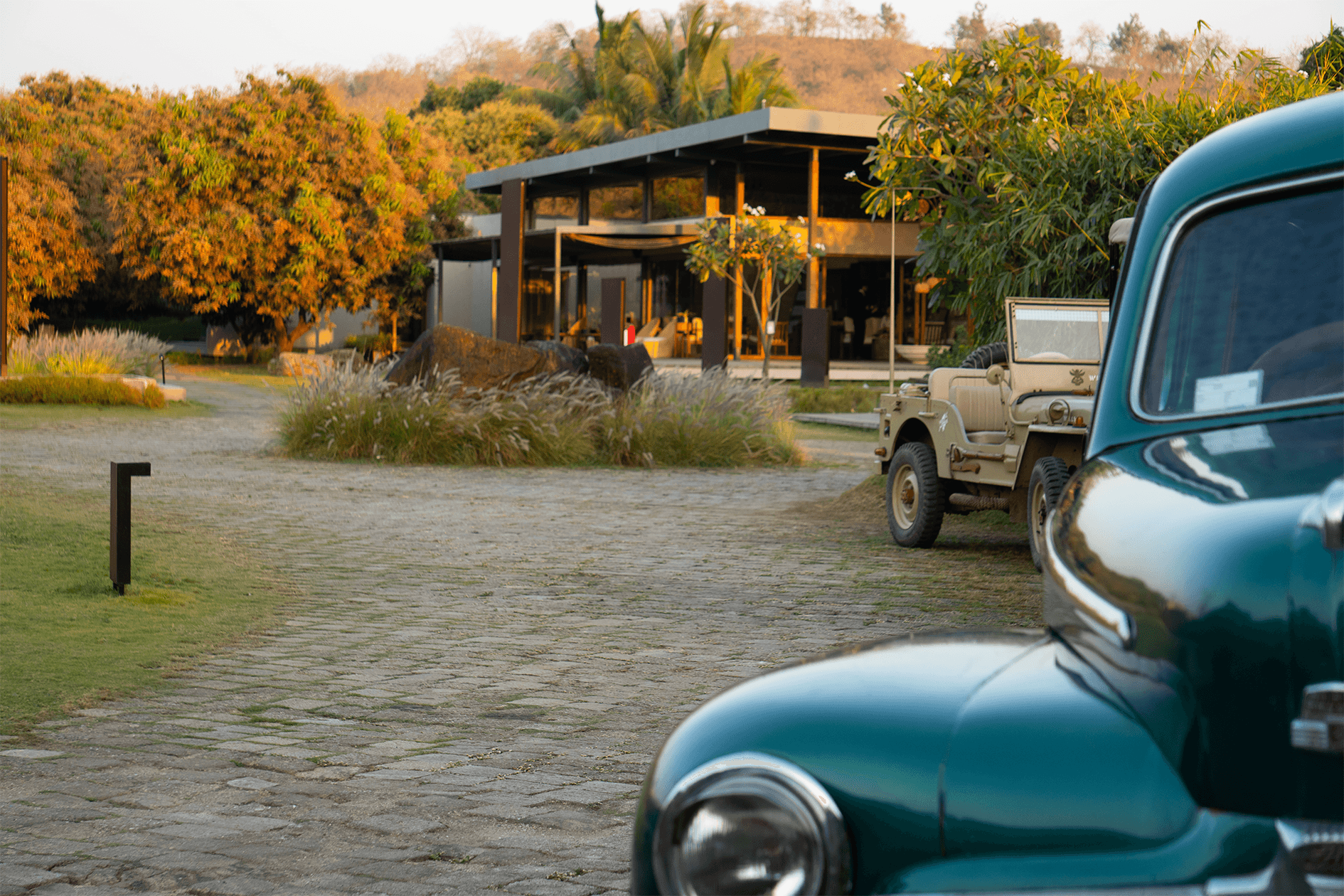
The sun reaches a room at Woods at Sasan before the guest inside it is awake. It falls across the bed at a particular angle each morning, because the window was placed to let it. Beyond the glass, mango trees hold their ground where they always have, and somewhere past them, if the light and the hour agree, a family of deer crosses without hurry. Nothing here was arranged for the view. The building was arranged around it.
This is biophilic design as Woods at Sasan practices it: not a style applied to a resort, but a discipline of listening to a place before drawing a single wall.
Windows Before Walls
Every structure on the property was designed for one condition first: that a guest should never fully lose sight of the outdoors. Full-height openings replace walls wherever the land allows it, so the orchard presses close against the glass in some rooms and opens into grassland near the public spaces. The Hiran river runs along the property's edge, changing through the seasons, and a guest sitting at its bank watches the forest do the same. Nothing about this view repeats itself twice. The architecture simply stayed out of its way.
What the Skin Remembers
Touch a wall here and it answers back with texture rather than polish. Local Bela and Dhangadhra stone and lime plaster hold the structure together, breathing with the weather rather than sealing against it. Furniture and textiles favour cane, cotton khadi, banana fibre, and bamboo: materials that were already part of this bio-region long before a resort stood on it. Enclosed rooms open onto decks so the boundary between indoors and out stays porous. Step outside and the smell of rain on dry earth, the sway of grass in a sudden wind, a lion calling somewhere past the tree line: these arrive as part of the room, not as an interruption to it.
Learning the Forest by Living In It
A stay here is built around encounter rather than observation. A morning with the horticulture team traces a meal back to the soil it grew in. A walk through the Som garden introduces the medicinal plants once kept by every household in this region. A naturalist leads guests into the forest itself, home to more than 300 recorded bird species, and forest bathing becomes less a wellness term than a return to something the body already knew how to do. On clear nights, a house telescope turns the sky into another kind of terrain to read, and a fire pit holds the evening together while the crickets take over the music.
Paths That Already Existed
Stephen Kellert, who did much of the foundational thinking on biophilic design, wrote that our affiliation with nature "must be nurtured through repeated and reinforcing experience." At Woods at Sasan, that nurturing starts with pattern. Walkways curve the way trails do when grazing animals wear them into a landscape, rather than cutting the shortest line between two points. Buildings sit where a sapling would choose to grow, following the light rather than competing with it. A guest's walk from the shared spaces to a room passes through the same layering a forest edge does on its own: open grass, scattered stone, a wooden deck, a roofed threshold, and finally the room itself. Nothing announces the transition. The body simply notices it has arrived somewhere quieter.
Objects That Remember Where They Came From
Design here carries the region's stories rather than illustrating them from a distance. Mata ni Pachedi, a textile craft native to this part of Gujarat, appears in the welcome card each guest receives, depicting the coexistence of the forest and the people who have always lived alongside it. A terracotta relief mural traces the region's ecosystem in clay. Mango leaves become a motif cut into wooden doors and pierced through corten steel panels. Cushions are layered in a technique borrowed from bird feathers, and nail-and-thread panels on the walls draw their patterns from local species. At reception, an installation follows wood, stone, and cotton from the earth they were born of toward the earth they will eventually return to.
What Returns to the Ground
None of this holds together without a closed loop underneath it. The property's original terrain was left largely as it was, so rainwater slows and seeps into the ground rather than running off it, and groundwater levels have risen as a result. Water drawn for the gardens is treated and returned to them. Kitchen waste and garden pruning go into a composter that feeds the soil that grows the next season's food. Bill Mollison, who shaped much of modern permaculture thinking, held that ethical design rests on three obligations: care for people, care for the land, and a fair share for all who depend on both. Woods at Sasan was built to keep that accounting honest, one season at a time.
By the time a guest wakes to that particular slant of morning light, none of this needs explaining. The wall is already cool to the touch. The window is already open to the orchard. The forest, once again, has already begun the day's design.
To see these rooms for yourself, the stays at Woods at Sasan are shaped by exactly this thinking, and the experiences built around them are where the forest does most of the talking.
FREQUENTLY ASKED
Questions we hear often.
What is a regenerative retreat?
How is regenerative different from eco-friendly?
What makes Woods at Sasan regenerative?


