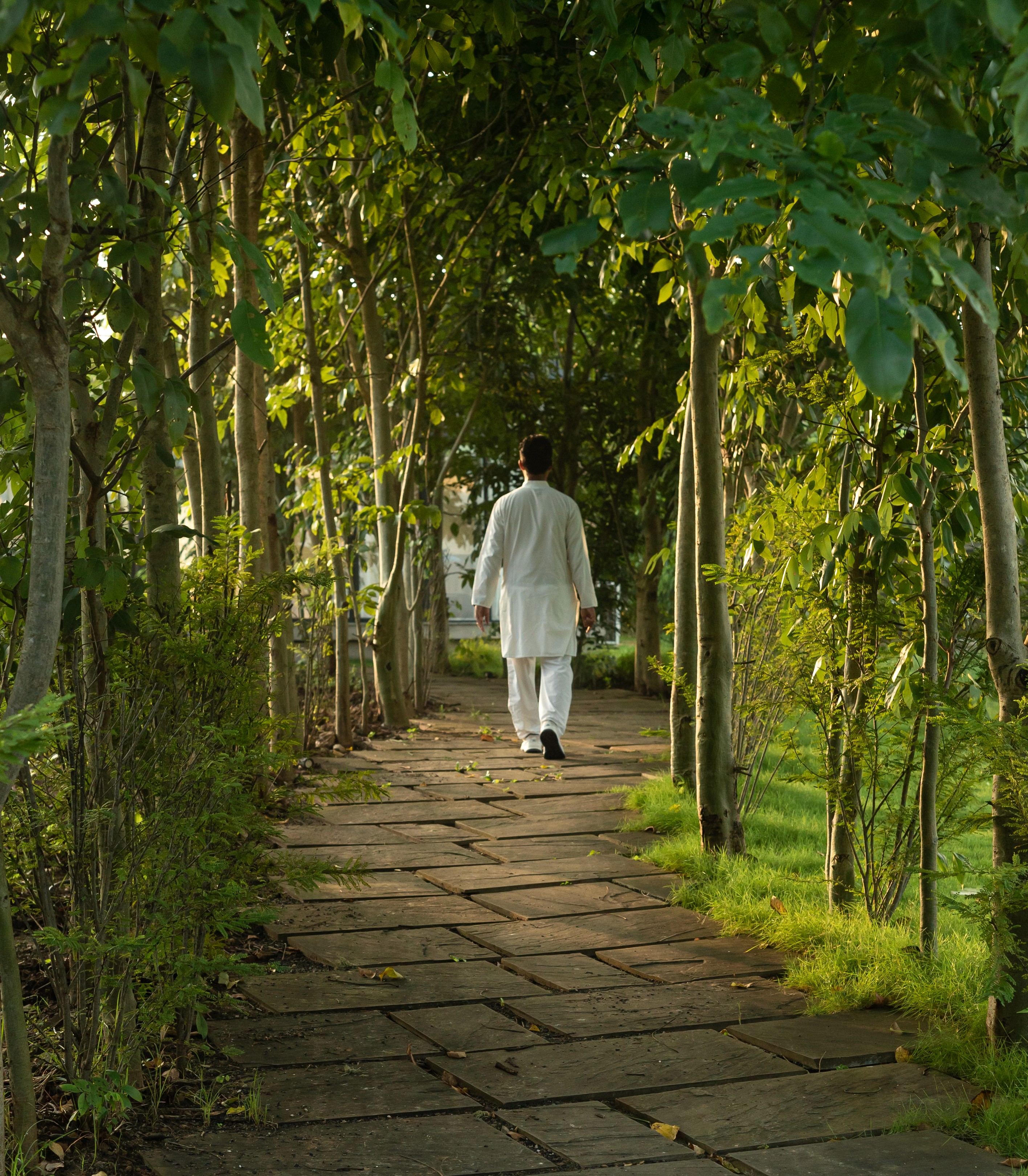
At six each morning, before the first guest has stirred, a young man from the Maldhari settlement walks the boundary road with two clay pots of buffalo milk balanced against his hip. He has done this since before there was a resort here, since there were only the 280 mango trees, the cattle paths between them, and the particular quiet of Gir before the forest wakes fully into birdsong. The milk still goes to the same houses it always did. Some of it now also goes to our kitchens. Nothing about his walk has changed to make room for us. We changed to make room for it.
This is as good a place as any to begin talking about regenerative hospitality, because the word is easy to say and much harder to practice. It is not a certificate on a wall, though we hold a few of those: an IGBC Platinum rating awarded in 2023, a GOPCA organic mark on the garden that feeds Swadesh. It is closer to a discipline of accounting: what did this place lose because we are standing on it, and what have we put back that wasn't here before.
Beyond Doing Less Harm
For a long while, hospitality measured itself by subtraction: fewer plastic straws, shorter showers, a smaller mark left behind. Woods at Sasan was built on a different premise, one closer to the older grammar of the land itself: that a dwelling should leave the ground more alive than it found it. The orchard's food forest is a few seasons old and already returning more to the soil food web than the construction ever took from it. The more than 40% of our workforce drawn from villages within a short walk of the property are not a hiring statistic so much as a return of livelihood to the ground it came from. Regeneration, in this sense, is not an adjective we apply to a resort. It is a relationship we owe to a watershed, a soil horizon, and the people whose provenance is this land, long before ours.
Building Without Clearing
When the first architects walked this ground, the brief was unusual: build a resort and fell nothing. The 280 mango trees stayed exactly where they had rooted, some for generations, and the rooms rose around them: walls of local Bela and Dhangadhra stone, finished in lime plaster that breathes rather than seals, corrugated roofs that insulate without demanding machinery to correct the temperature they hold. Reclaimed teak carries the grain of buildings that came before this one. Khadi, terracotta, bamboo: each material chosen because it already belonged to this bio-region, and asking little of it in return.
This is the quieter half of what people mean when they search for biophilic design in India: not glass towers dressed in greenery, but a vernacular remembered rather than invented: stone that already knew how to keep a Gujarat summer cool, plaster that already knew how to let a wall breathe.
A Kitchen That Answers to the Season
Regenerative hospitality has to eat somewhere, and here it eats mostly from within walking distance. Over 60% of what reaches the table is sourced locally, a share that grows each season as our own edible garden matures. Kaaki's Kathiawadi thali at Swadesh carries dairy from the Maldhari herds down the road, forgotten monsoon greens foraged rather than farmed, grains that predate the varieties bred for yield over flavour. Nothing here is styled to look rooted. It simply is: soil to garden to kitchen to plate, with as few hands and as few miles between each step as the season allows.
What Returns to the Ground
Composting, water recycling, native planting: these sound like line items until you have watched them at work. The kitchen scraps that once left the property now return to the food forest as compost. The water that once ran off toward the Hiran now recharges the ground it fell on. Birds that had thinned out of the orchard over the years of surrounding farmland have started coming back, drawn by cover and food that weren't there before. None of this is dramatic. It is patient, cumulative, and slow to notice unless you are the kind of guest who asks to see the back of house rather than only the front of it, which some do, and which we are always glad to show.
The People Who Hold It Together
None of this holds without the people who tend it daily: the naturalists who read the forest like a familiar text, the housekeeping artisans who fold khadi and leave a wildflower on a desk, the potter whose wheel has taught more than one guest something about patience they didn't come looking for. Over thirty artisan collaborations run through this property, each one a small act of keeping a craft alive that market forces alone would have let fade: Lippan mudwork from Kutch, Mata ni Pachedi textiles, thread art from Borvaav. Regeneration, done honestly, is as much about cultural memory as it is about soil.
An Invitation, Not a Performance
None of this is offered to be watched. A guest who walks the food forest, sits with the potter, or joins a back-of-house tour is not observing a system that runs regardless of them. They are, for the length of their stay, part of what keeps it running. The compost pile grows a little with every meal eaten here. The orchard is a little more visited, a little more looked after, for every set of eyes that noticed a bird they hadn't seen before.
If this is the kind of reciprocity you're looking to spend time inside, rather than simply read about, our pathways are built around exactly this rhythm. The orchard rooms themselves are where it begins each morning, with the light and the birdsong arriving together, well before the day asks anything of you at all.
FREQUENTLY ASKED
Questions we hear often.
What is a regenerative retreat?
How is regenerative different from eco-friendly?
What makes Woods at Sasan regenerative?


